Roaming.Camp
Camping in Tennessee

Tennessee

The Volunteer State

Tennessee is a mountain state on one end and a river state on the other, and camping here changes character every hundred miles. The eastern third belongs to the Appalachians: Great Smoky Mountains National Park, the most-visited national park in the country, plus more than 650,000 acres of Cherokee National Forest running the length of the North Carolina line and roughly 290 miles of the Appalachian Trail along the crest. The middle is the Cumberland Plateau — a sandstone tableland cut by gorges at Big South Fork and the Obed, with more waterfalls than any comparable stretch in the East. West of Nashville the land flattens into the Highland Rim and the Natchez Trace Parkway, and finally into Mississippi River bottomland. Clear reservoirs like Dale Hollow and Watauga fill the valleys between. Fall is the headline season — October color rolls downhill for six weeks — but the Ocoee's summer whitewater and the Smokies' spring wildflowers make the shoulders worth planning around.

Top 10 sites

The places we'd send you first.

No. 1

Cades Cove Campground — Great Smoky Mountains

NPS · TN

The most famous campground in the Smokies, set beside an 11-mile loop road through a broad mountain valley where black bears, white-tailed deer, and wild turkey graze open pasture at dawn and dusk. 161 sites, open year-round, with flush toilets, drinking water, and food storage lockers — but no hookups, no showers, and no cell signal. Historic churches, a working gristmill, and log homesteads line the loop. Reserve on Recreation.gov up to six months ahead; summer and October weekends go the day they open.

When to go

Tennessee's dominant weather variable is elevation. The state runs from roughly 180 feet on the Mississippi floodplain to 6,643 feet at Kuwohi, and that spread can mean a 20-degree difference and an entirely different forecast between your campsite and the ridge above it. Humidity drives summer discomfort more than raw temperature does. Rainfall is heavy and spread through the year — the high Smokies take in over 80 inches annually, closer to a temperate rainforest than anywhere else in the region — so pack rain gear in every season.

Spring

Mar–May

Wildflowers first, water second. The Smokies' spring ephemeral bloom peaks in April and is one of the richest displays in North America, with Cades Cove and the Little River corridor leading it. Waterfalls run hard on spring rain, and the Obed and Big South Fork hit their whitewater season. Dogwood and redbud light up Middle Tennessee. Expect real volatility: severe thunderstorm and tornado risk peaks in March and April, and high-elevation nights still drop below freezing into May. Crowds stay moderate until Memorial Day, and reservations are far easier to get than in October.

Summer

Jun–Aug

Hot, humid, and busy, with afternoon thunderstorms most days. Lowland highs run in the low 90s with heavy humidity, and the payoff is that elevation genuinely helps — Newfound Gap and the Cherohala Skyway can run 15–20 degrees cooler than Knoxville. This is peak water season: the Ocoee runs scheduled dam releases, lake campgrounds fill, and the swim beaches at Indian Boundary and Chilhowee become the main event. The synchronous firefly display at Elkmont falls in late May or early June, by lottery. Book Smokies campgrounds well ahead; July weekends are effectively sold out.

Fall

Peak season

Sep–Nov

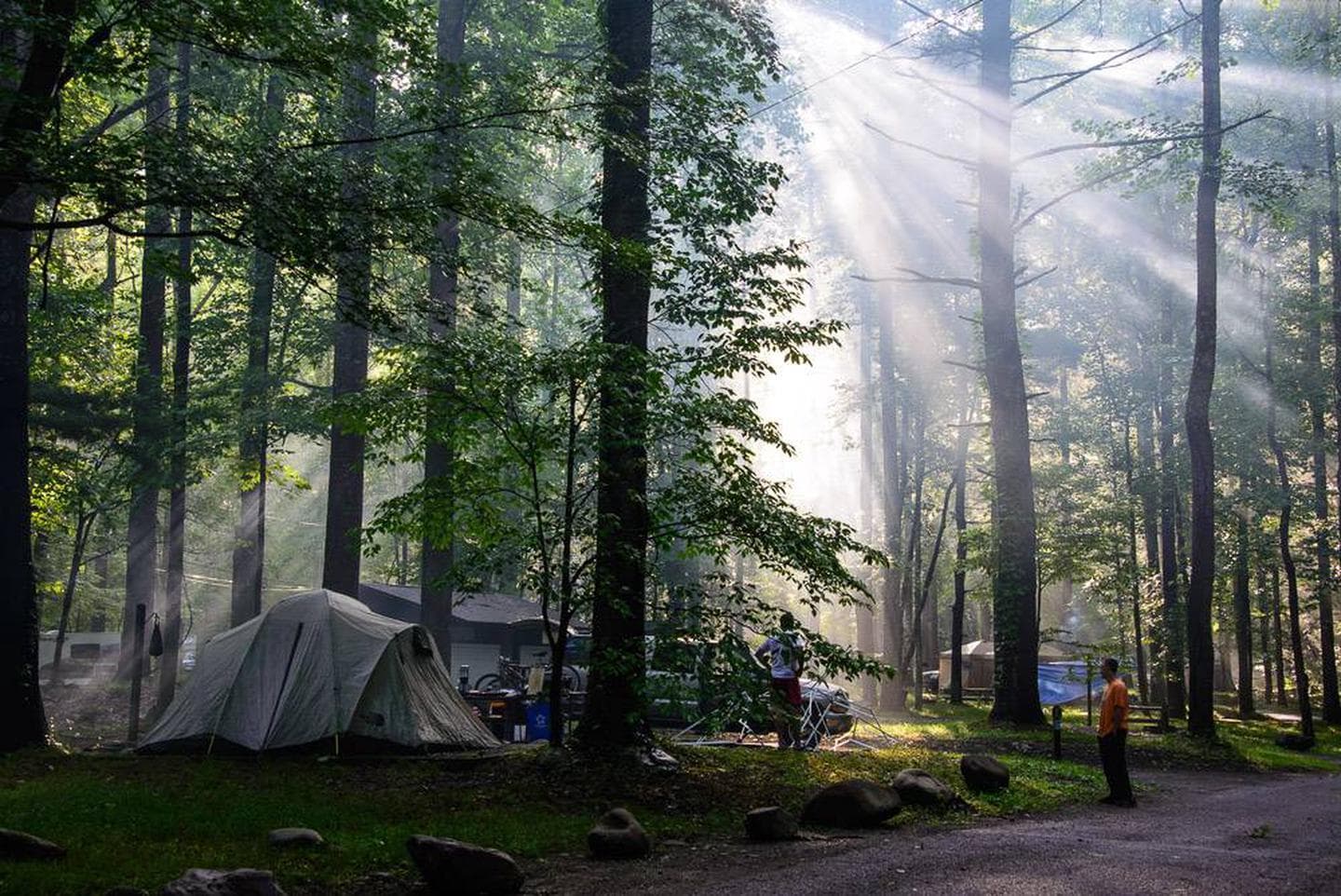
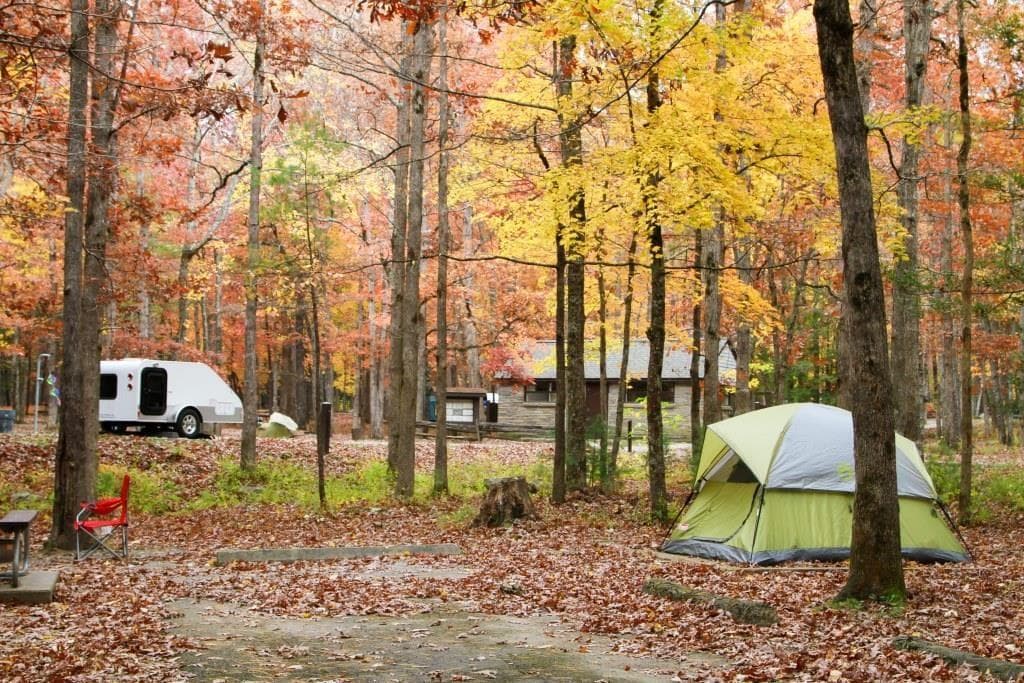
The best camping season in Tennessee, and the reason the state's campgrounds sell out. Color starts above 5,000 feet in late September and works downhill through October, reaching the valleys and Middle Tennessee in early November — a rolling six-week display. Humidity breaks, the bugs disappear, days stay warm and nights turn cool, and the light coming through hardwood canopy is the whole point. The catch is traffic: the Smokies see their heaviest visitation of the year in October, the Cades Cove Loop Road can back up for hours, and October weekend campsites should be booked six months out.

Winter

Dec–Feb

Mild by northern standards and genuinely quiet. Valley lows sit in the upper 20s to low 30s and snow rarely sticks below 2,000 feet, but the high Smokies get real winter — the road to Kuwohi closes from December through March, and Newfound Gap Road can shut with little notice during ice storms. Cades Cove and Bandy Creek stay open year-round; most Forest Service campgrounds close for the season. Bare trees open up ridge views that summer foliage hides, and the tailwater below Dale Hollow Dam is prime bald-eagle watching from late fall into early spring.
Know before you go

Best time

Window
Sep–Nov
Peak — Fall
Sep–Nov
Spring
Mar–May
Summer
Jun–Aug
Fall
Sep–Nov
Winter
Dec–Feb

The best camping season in Tennessee, and the reason the state's campgrounds sell out. Color starts above 5,000 feet in late September and works downhill through October, reaching the valleys and Middle Tennessee in early November — a rolling six-week display. Humidity breaks, the bugs disappear, days stay warm and nights turn cool, and the light coming through hardwood canopy is the whole point. The catch is traffic: the Smokies see their heaviest visitation of the year in October, the Cades Cove Loop Road can back up for hours, and October weekend campsites should be booked six months out.

Reservations

Booking
Recreation.gov
Window opens
6 months out
First-come sites
Mixed · arrive early
Cancellation
48 hr · per facility
Peak weekends
Book on release

For the Smokies in October, six months — the full Recreation.gov booking window, the morning it opens. Cades Cove and Elkmont fill for fall color and summer weekends almost immediately, and Elkmont during the synchronous firefly…

Permits & signal

Backcountry
Permit required
Dispersed
USFS · BLM · 14 days
Fire restrictions
Seasonal · check ranger
Signal · Verizon
Fair
Signal · AT&T
Fair
Signal · T-Mobile
Poor

Yes, mostly on national forest land. The Cherokee National Forest allows dispersed camping across much of its two districts outside of developed recreation areas, generally free and without a permit, subject to distance rules from roads…

Camping etiquette

Quiet hours
10 PM – 6 AM
Pets
Leashed · 6 ft
Pack-out
All waste
Food storage
Bear box / hang
Stay limit
14 days · 30 day window

Yes, mostly on national forest land. The Cherokee National Forest allows dispersed camping across much of its two districts outside of developed recreation areas, generally free and without a permit, subject to distance rules from roads…

Frequently asked

Fall is the peak, and it is not close. Color begins above 5,000 feet in late September and rolls downhill through October into early November, giving roughly six weeks of prime camping with broken humidity, no bugs, warm days, and cool nights. The tradeoff is crowding — October is the Smokies' busiest month, and campsites should be reserved six months ahead. Spring is the connoisseur's alternative: April wildflowers in the Smokies are world-class, waterfalls run hard, and reservations are easy, though severe storms are a real risk. Summer is hot and humid in the lowlands but excellent for whitewater and lake swimming, and elevation offers genuine relief. Winter is quiet and mild in the valleys, with most Forest Service campgrounds closed but Cades Cove and Bandy Creek open year-round.